Phosphate Glass
After watching a video from the youtube channel Apoptosis about his attempts at making alums from rare earth elements,1 I was inspired to do some rare earth chemistry myself. I was particularly interested in how the rare earth salts would change color depending on the kind of light they were in, and wanted to see if I could make glass with this property. I read that phosphate glasses have a high solubility for rare earth ions and aren’t too difficult to make, so I decided to try it.
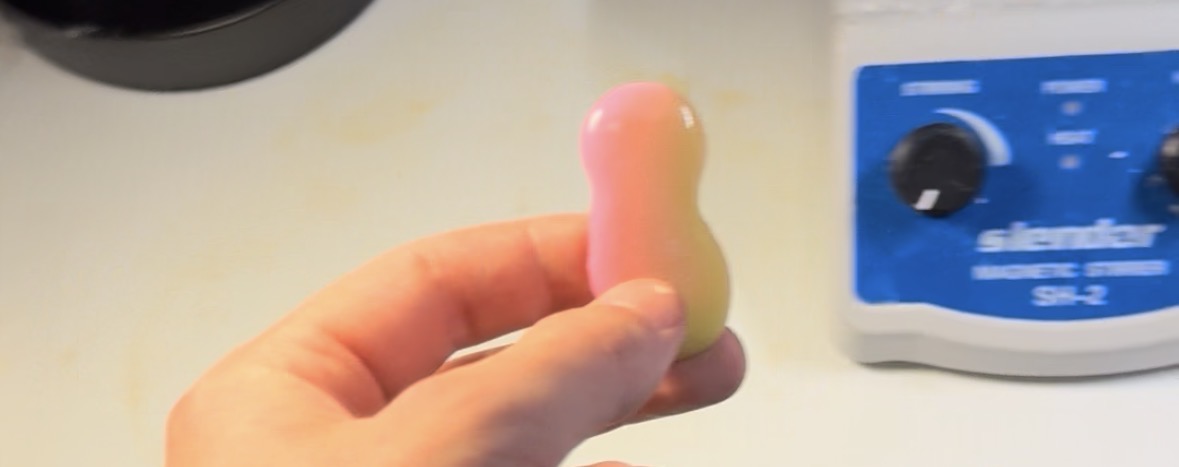
What is Phosphate Glass?
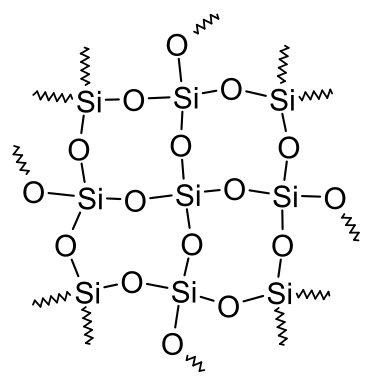
Most glass is made from silicon oxide, where a bunch of silicon atoms are connected together by oxygen atoms.
It turns out you can replace silicon with many other elements and still get something similar to normal glass. As an example, strongly heating borax will cause it to decompose into boron oxide2, which can form borate glass when it cools.
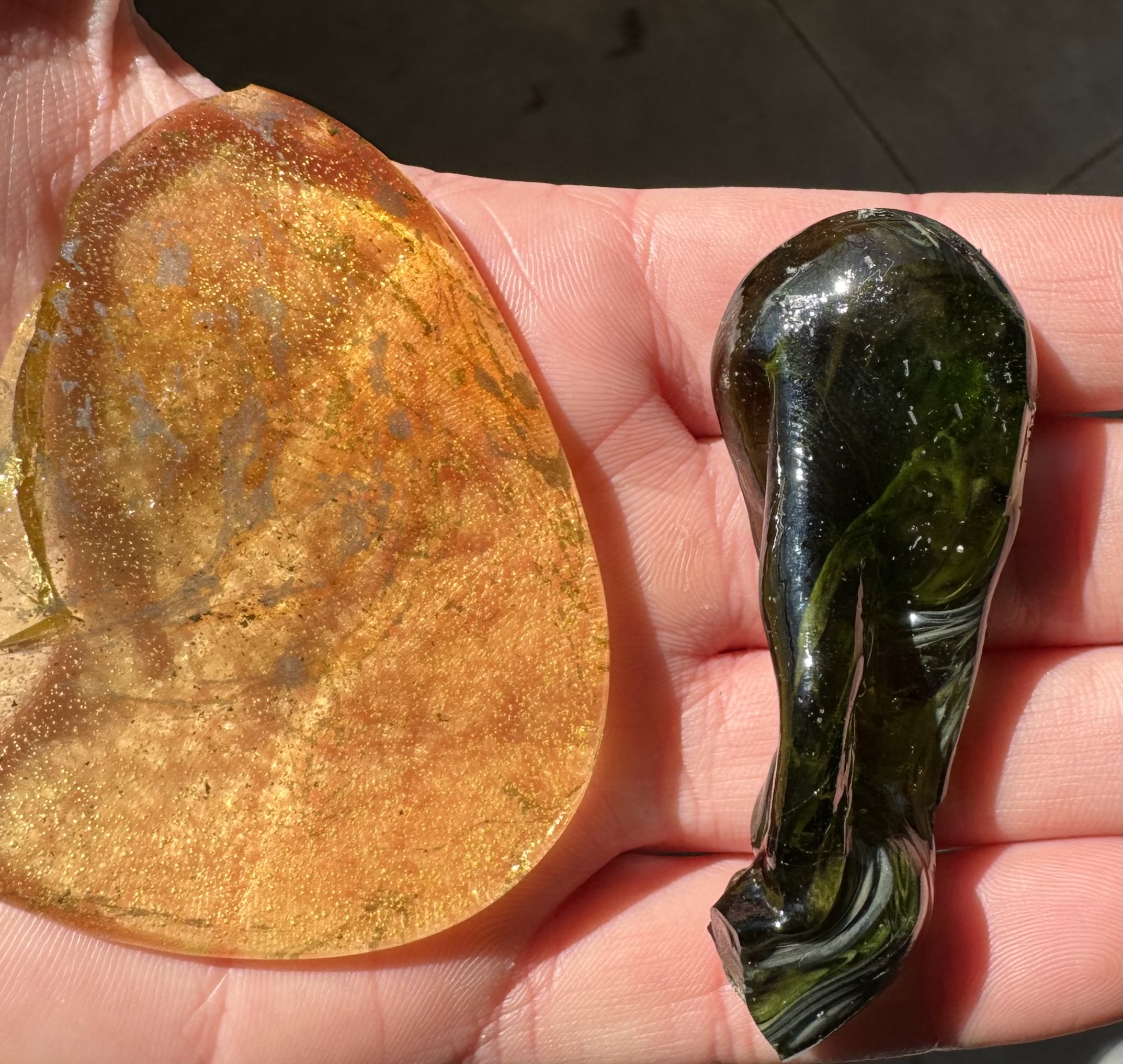
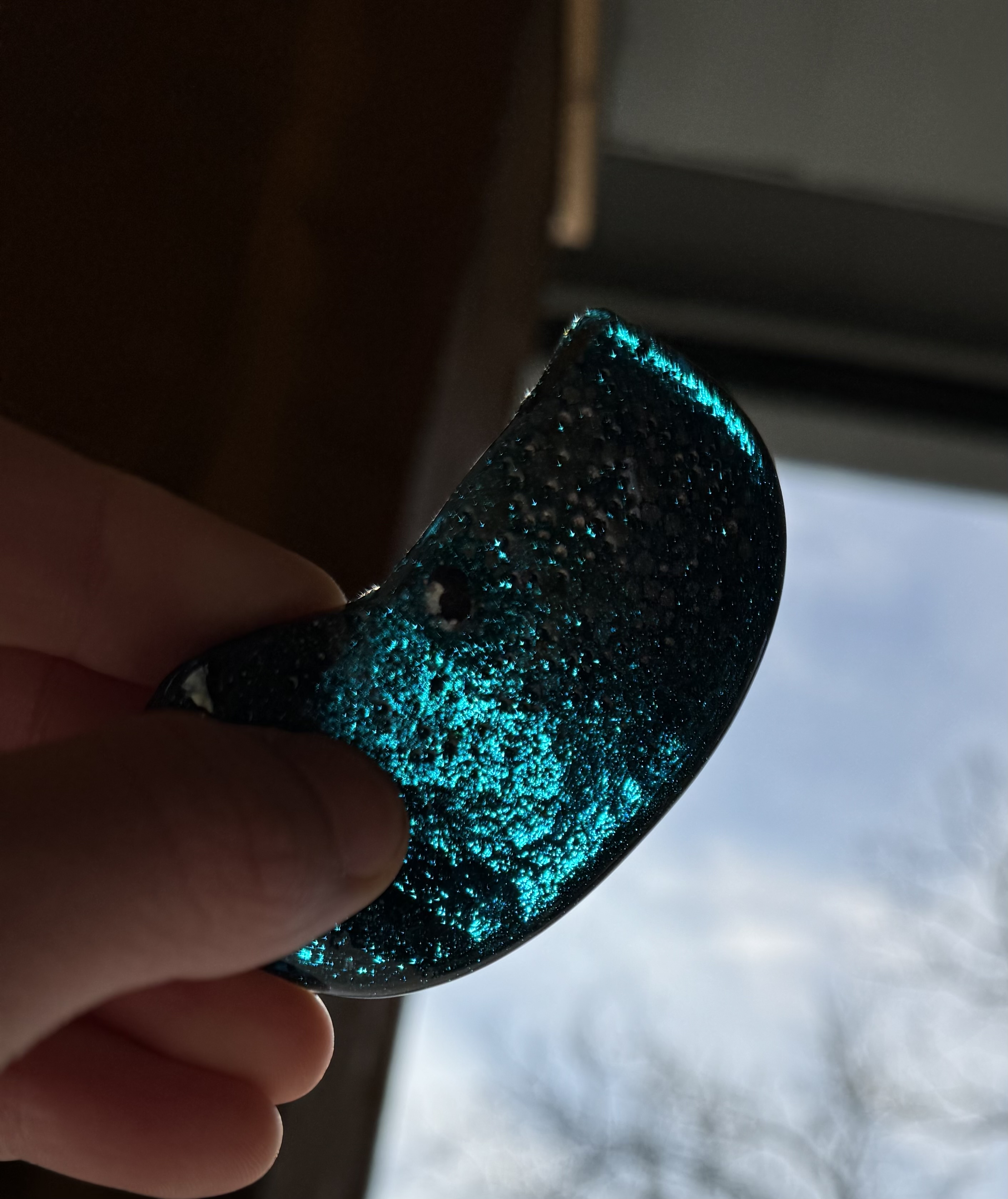
Phosphate glass is made by replacing silicon with phosphorus, meaning I’d need to melt down some phosphorus oxide.
Glass colors
If all normal glass is made of silicon oxide, how do we have so many different colors of glass? There are multiple ways to make colored glass, but a common one is to add a small amount of a transition metal oxide to the silicon oxide, where the metal you choose determines the color. For example, iron oxide gives a green color, and copper oxide makes blue glass. For this project, I’d still be using metal oxides as dopants, but instead of transition metals, I’d use rare earth metals.
Other additives
Normal silicate glass often includes more than just the silicon and the coloring metal. It’s common to add some sodium oxide to lower the melting point, and calcium oxide to keep the glass from being water soluble. Aluminum oxide can be added to make the glass stronger and more chemically durable. Many of these additives have a similar effect in phosphate glass, so I used them as well. The exact composition I went with was a modified version of the neodymium-doped alumino-phosphate laser glass described by Muñoz-Quiñonero et al.3 The main difference is that I replaced barium oxide with the less toxic calcium oxide. It roughly consists of4:
- 57% Phosphorus pentoxide
- 15% Potassium oxide
- 10% Sodium oxide
- 8% Calcium oxide
- 6% Rare earth oxide
- 4% Aluminum oxide
Preparing the Rare Earth Salts
I decided to make glass doped with praseodymium, holmium, neodymium, erbium, europium, terbium, gadolinium, and dysprosium. The first step was to convert the rare earth metals I had into salts that would dissolve in the glass melt. Oxides are what I really needed for the glass, but carbonates would also work since they decompose into oxides at high temperature. I figured the easiest way to do things would be to dissolve the metals in acid, and then precipitate out insoluble carbonates by adding sodium carbonate.
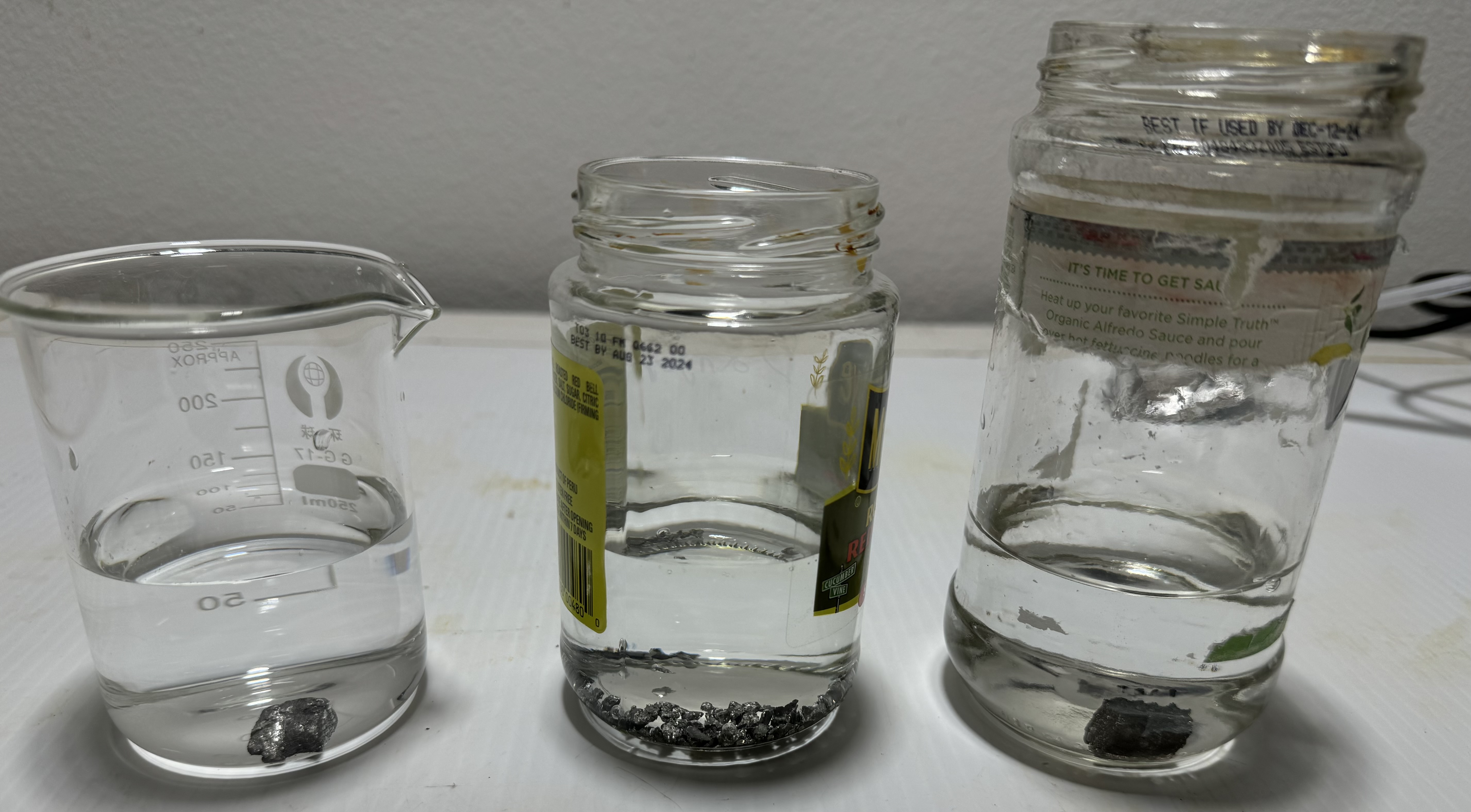
Following Apoptosis, I dissolved all but the europium in sulfuric acid, making the corresponding sulfate salts. In hindsight, I probably should have used hydrochloric acid instead. Several rare earth sulfates have retrograde solubility, meaning they become less soluble as the temperature increases. Unfortunately, the process of the metal dissolving releases heat, so it took a very long time for the metals to dissolve. Since I had no plans of making alums like Apoptosis, there was no benefit to making sulfate salts over chlorides.
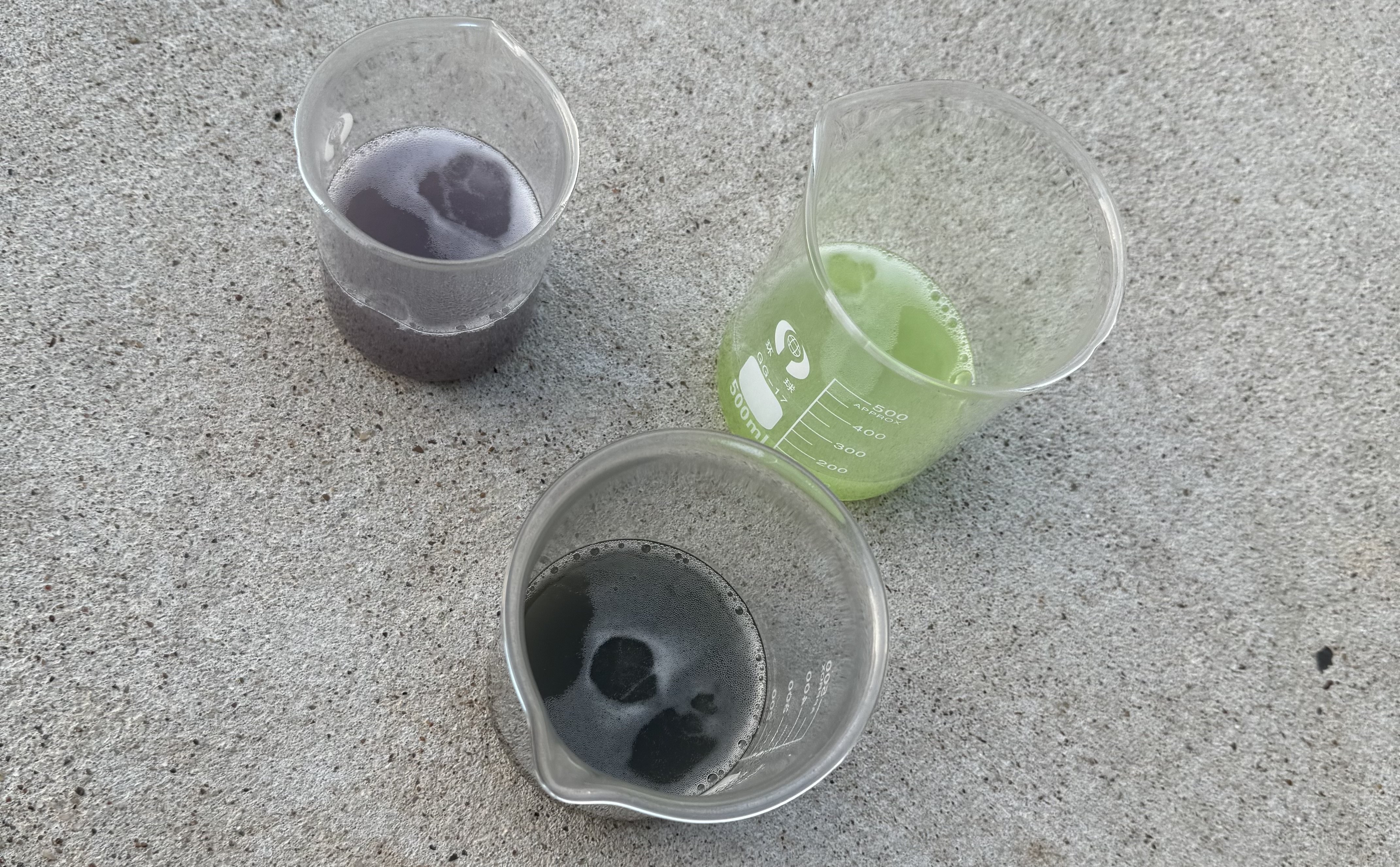
Europium can be converted to its hydroxide by just adding water, so I didn’t bother using any acid on it.
Europium likes to be in the +2 oxidation state, but I wanted the +3 state for the glass, so I added some hydrogen peroxide after everything had reacted with the water.
After drying, this was ready to be used for the glass, and I could go back to working on the other salts.
The holmium solution immediately displayed the color changing effect I was looking for.
This isn’t a camera artifact, the solution really looks this way in real life. For an explanation of why this happens, see the Apoptosis video linked at the beginning of this post. Unfortunately none of the other rare earths had anywhere near as strong of a change.
After playing around with this for a bit, it was time to convert all my sulfate salts into carbonates. I boiled them down for a while so I’d have less water to filter off, and then added sodium carbonate to each solution. I only got video of this for holmium, but the process was identical for all the other rare earths.
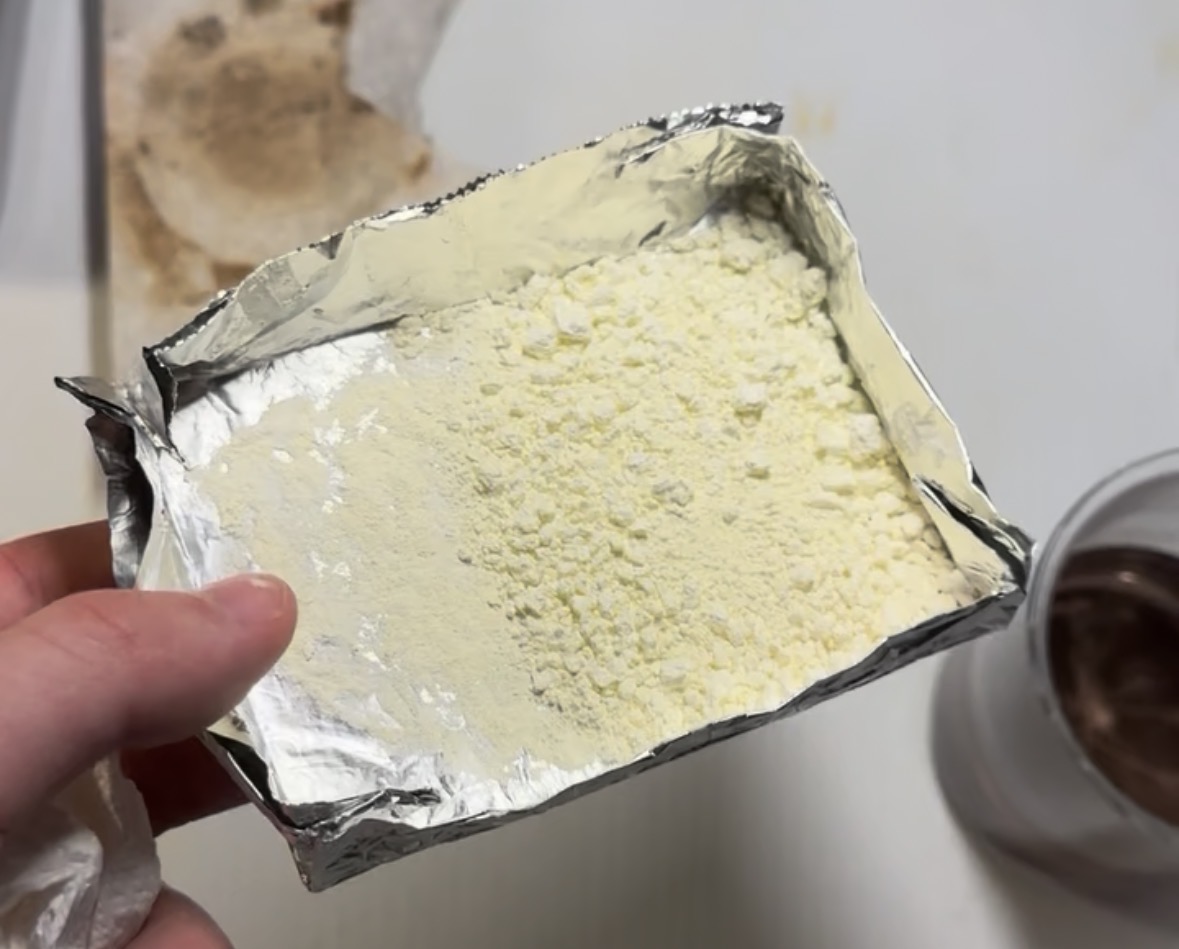
The precipitate formed instantly, and was filtered off and dried. My rare earths were now in a form that could be used for the glass!
Making the Glass
At this point we could simply mix the ingredients in the ratios described earlier, and throw it in the furnace!5
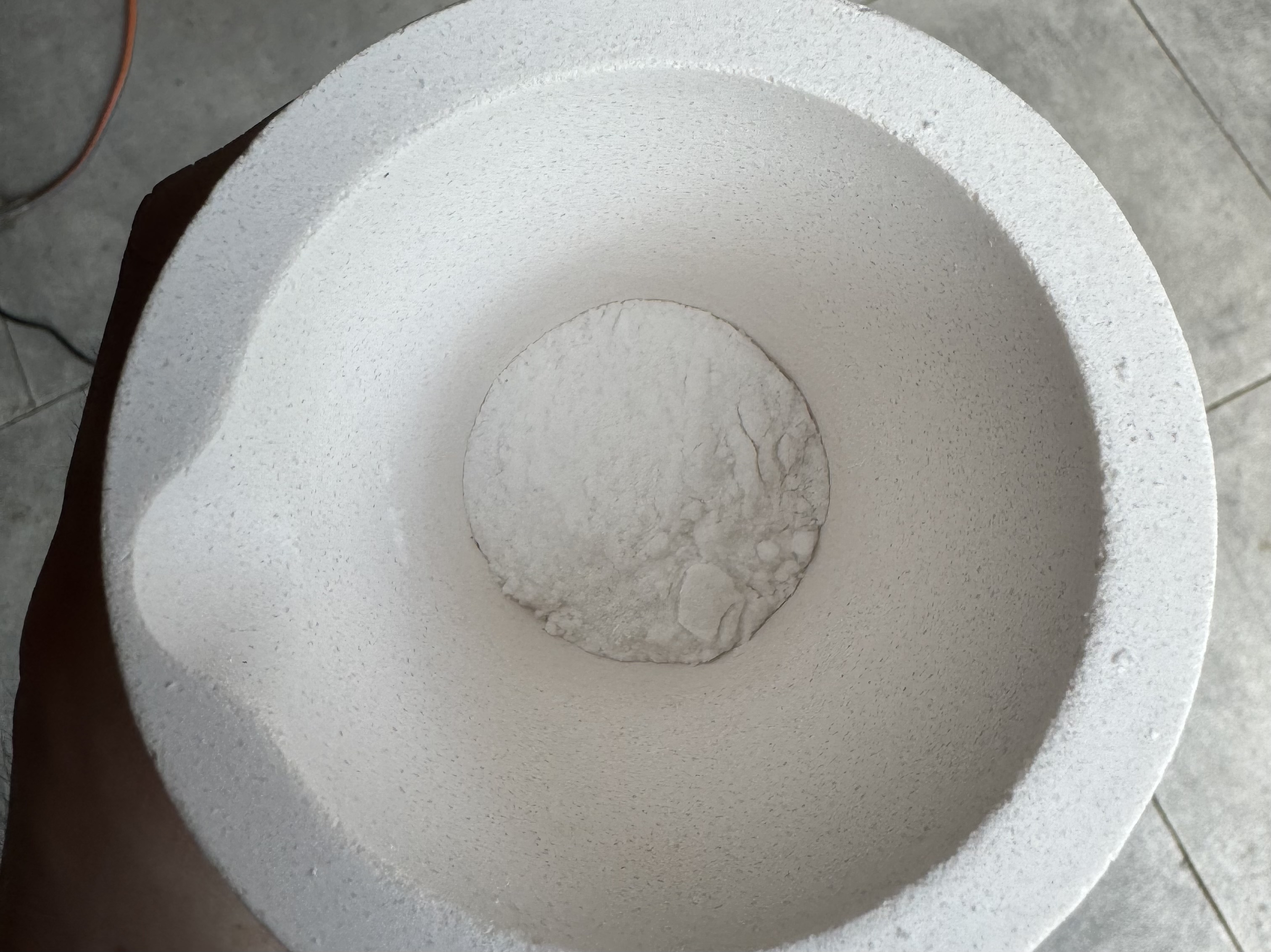
After heating to around 2000°F for an hour, everything had melted together and I could pour out the glass.
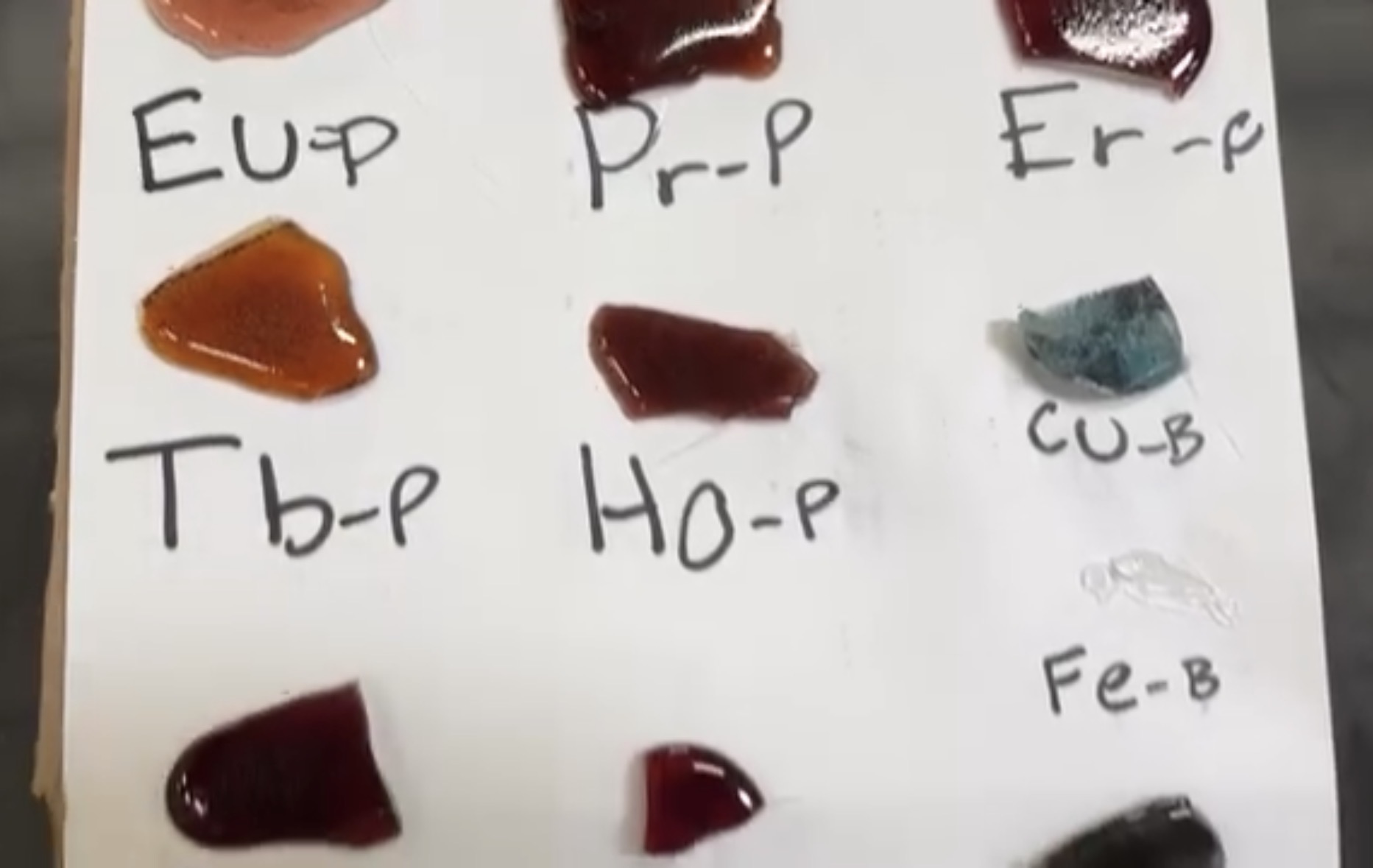
After many hours repeating this for each rare earth, I had a nice collection of phosphate glasses.
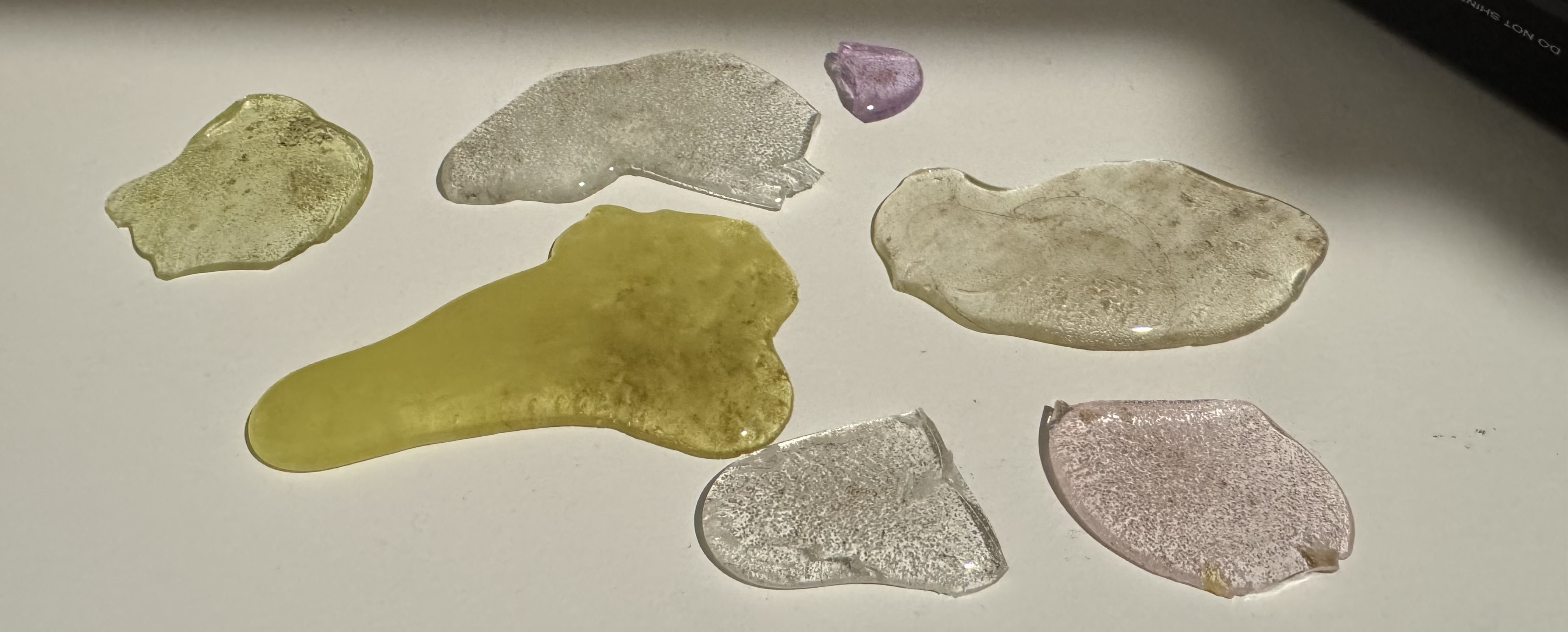
The holmium-doped glass changed color just like the solution.
The other interesting results were the terbium and europium glasses. Both are colorless in normal light, but under UV light the terbium glass glows green and the europium glass glows red. Surprisingly, the undoped phosphate glass glows blue under UV.
What if we put it in a particle accelerator?
The legends at Electron Impressions were kind enough to send some of the glass I made through an electron accelerator, and the results were pretty cool.
The glasses glowed all different colors as they passed through the beam.
After, the glass was discolored, but returned to normal after a few days.
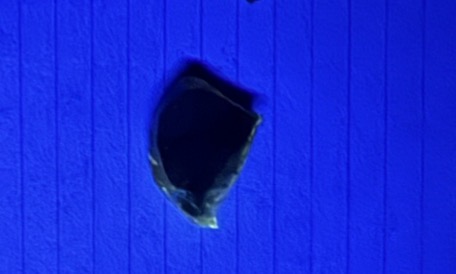
The terbium-doped glass was temporarily thermoluminescent, and would glow green when heated.
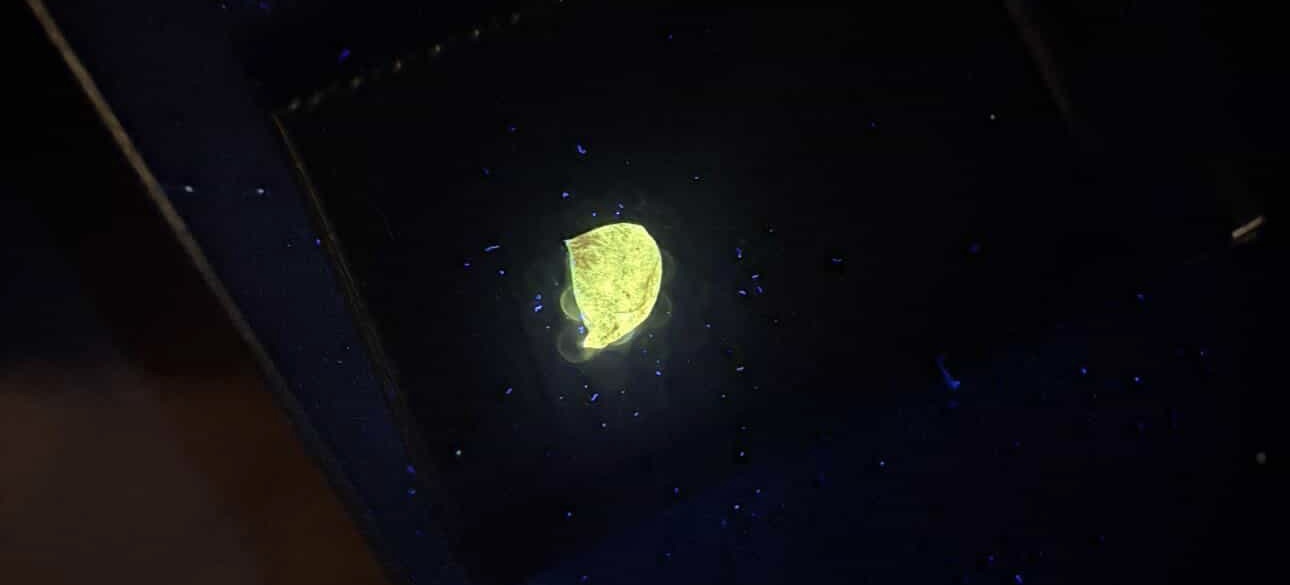
Surprisingly, the copper-doped borate glass seems to have become fluorescent, and glows yellow under UV light now. I’m not sure why this happened, my best guess is something related to some of the copper(II) getting converted to copper(I).
Gold glass
As mentioned earlier, metal oxides are not the only way to make colored glass. Another way is to use a metal directly, in the form of nanoparticles suspended in the glass. For a long time, red glass was made using gold nanoparticles, and I wanted to try this out myself.
I had 100 mg of gold metal I was willing to sacrifice for this experiment, and the first step would be working out how to convert it to nanoparticles. No mechanical process, like grinding it up, would be able to create small enough particles, so I’d have to do some chemistry. Similar to a method I found in a ScienceMadness thread,6 my plan was to dissolve the gold in acid, add the solution to some powdered glass, and melt everything together. Hopefully as the gold solution decomposes in the heat, I’d end up with nanoparticles that color the glass red.
Gold is extremely resistant to most acids, and none I had were capable of dissolving it. Luckily, a mixture of two acids I had, hydrochloric acid and nitric acid, could dissolve gold by working together. The basic reason for this is that to dissolve gold, you need oxidizing chemistry to rip away some of its electrons, and enough chloride around to stabilize the oxidized gold as chloroauric acid. Nitric acid is oxidizing but lacks chloride, and hydrochloric acid has chloride but isn’t oxidizing. When mixed, they form a solution known as “aqua regia”, which is capable of dissolving gold.
Both acids are clear, but mixing them causes the solution to turn orange, from the formation of nitrosyl chloride and chlorine gas. Both of these are very toxic, so don’t try this if you don’t know what you’re doing.
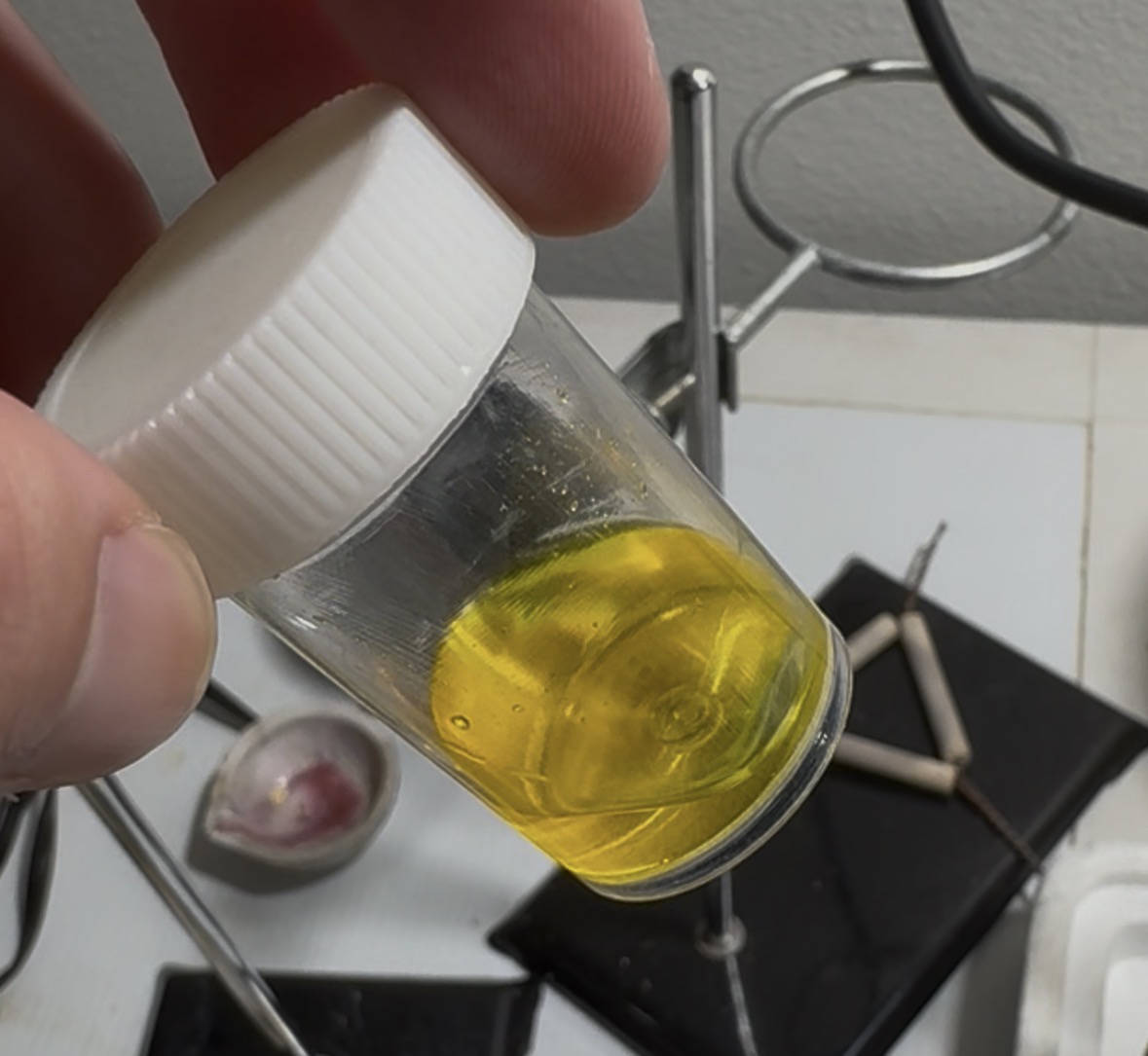
At room temperature, the gold dissolves very slowly, so I used an oil bath to heat the test tube and speed up the process. After everything dissolved I kept heating to boil off most of the water. At the end I was left with a few milliliters of a bright yellow solution of chloroauric acid.
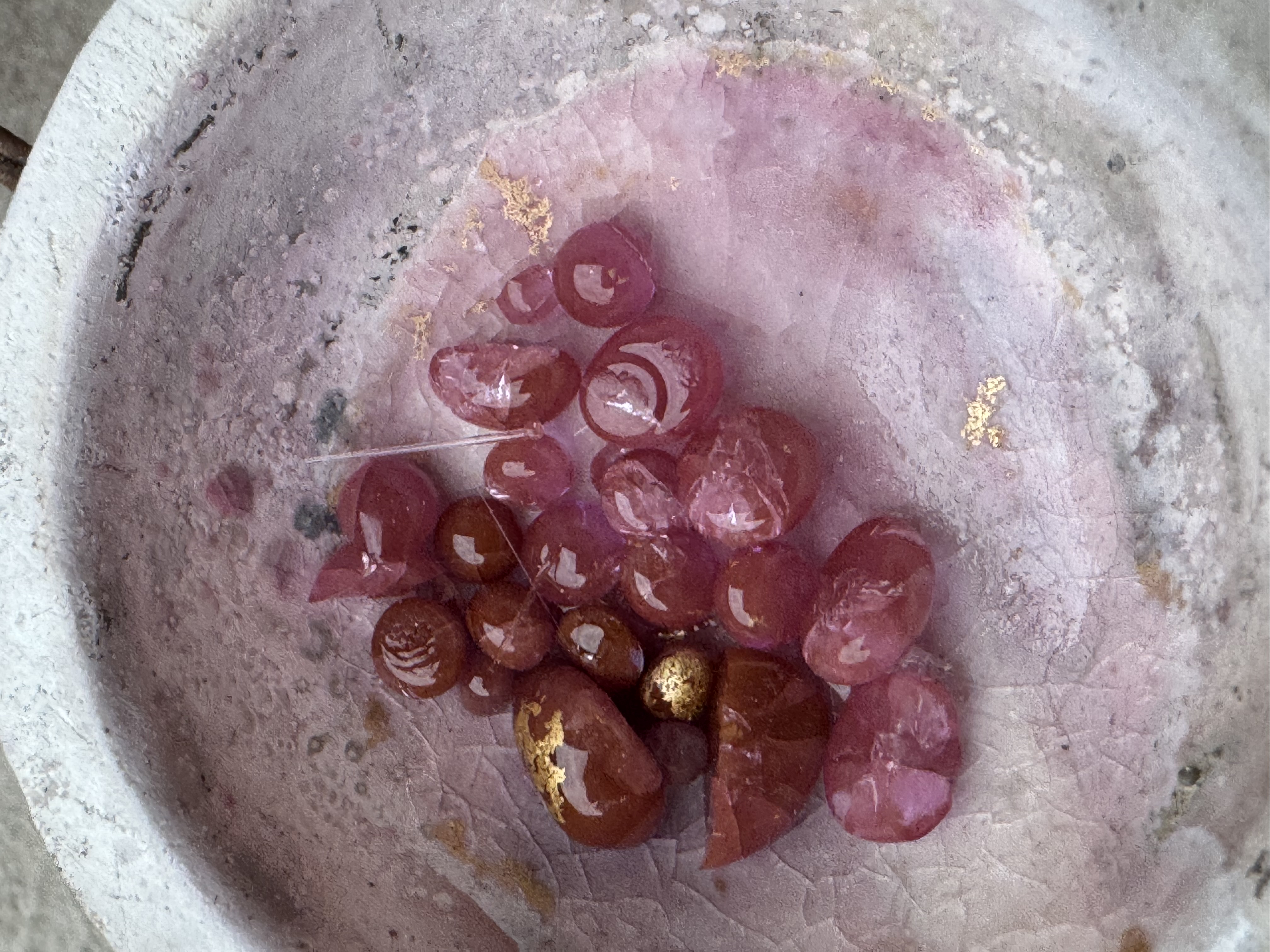
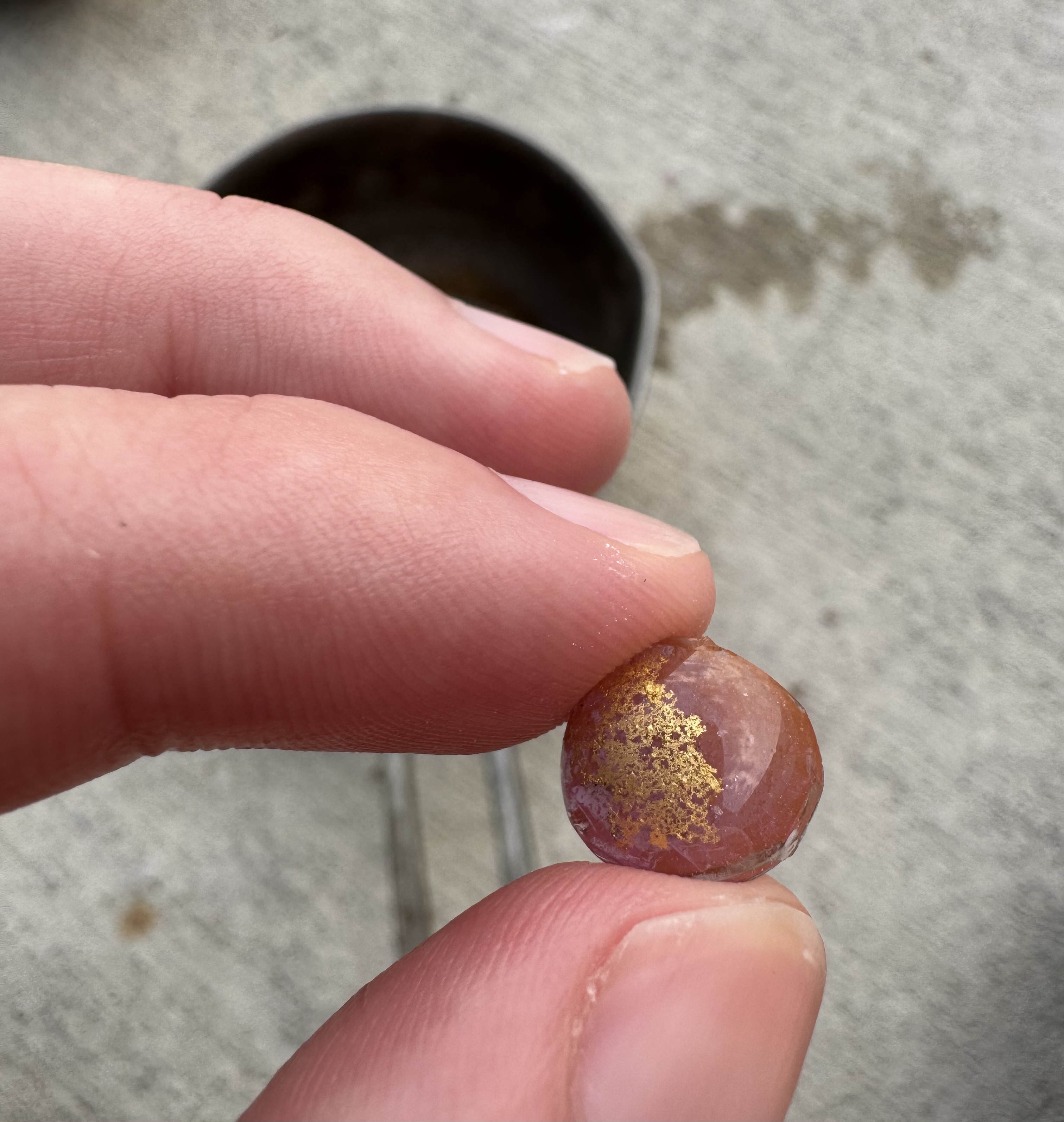
After adding a few drops to some powdered glass and melting it, I ended up with a nice red glass!
Surprisingly, some of the gold formed larger chunks and rose to the surface, making a cool effect.
Future work
Phosphate glasses doped with other elements have many other cool properties I’d like to explore in the future. Photochromic alumino-phosphate glass can use silver and halides to darken under UV light,7 and phosphate glass doped with silver nanoparticles, erbium, and ytterbium can apparently do upconversion, where it absorbs photons of infrared light and emits visible light8. This has always seemed cool to me because it doesn’t seem like it should be possible to get higher energy light from lower energy light9. I’d also really like to make phosphorescent (glow in the dark) glass by suspending strontium aluminate in the glass. I’ll keep this page updated if I ever get to any of these!
Footnotes
-
Apoptosis, video on making rare-earth alums, YouTube, https://www.youtube.com/watch?v=jEOhfFwfdYA&t=199s. ↩
-
Sodium oxide is also produced in the decomposition, but boron oxide is what forms the glass ↩
-
Mónica Muñoz-Quiñonero et al., “Dehydroxylation processing and lasing properties of a Nd alumino-phosphate glass,” Journal of Alloys and Compounds 896 (2022): 163040, https://doi.org/10.1016/j.jallcom.2021.163040. ↩
-
What I really used was a mixture of compounds that decompose into the above oxides at high temperature, as this is much easier than preparing all the oxides beforehand. The composition I put in the furnace was (by weight):
- 60%
- 14%
- 11%
- 7%
- 5%
- 3%
-
Be aware that if you follow my method of using , ammonia gas will be produced as soon as the ingredients are mixed. ↩
-
ScienceMadness forum thread, “Gold ruby glass,” https://www.sciencemadness.org/talk/viewthread.php?tid=77433. ↩
-
Edric Ellis, Richard Gelder, and Allan Hale, “Photochromic alumino-phosphate glasses,” U.S. Patent 4,088,501, issued May 9, 1978, https://patentimages.storage.googleapis.com/97/24/02/26d4efb9c160eb/US4088501.pdf. ↩
-
Chengguo Ming et al., “Optical character of co-doped phosphate glass,” Optics Communications 284, no. 7 (2011): 1868-1871, https://doi.org/10.1016/j.optcom.2010.12.011. ↩
-
Upconversion is possible because the material can absorb two photons of low energy infrared light, and then emit one photon of higher energy visible light. ↩